

UN SDG Impact Alignment
Leveraging our Products & Services Revenue Datafeed as well as our granular product level impact data like recalls, we provide unparalleled insights into the SDG contributions of a company’s products & services on top of its operations, all quantified in monetized impact terms in alignment with impact accounting principles.
Mapping to Products & Services
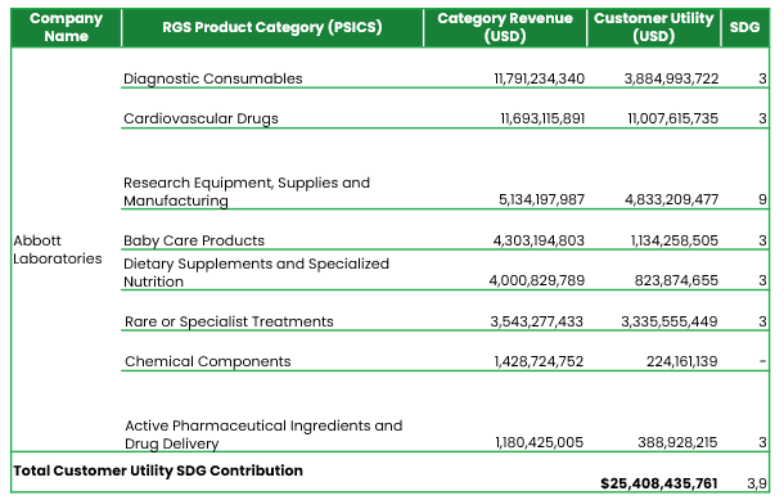
We collect a company’s revenue breakdown by business segments and map it to over 350 product & services categories (RGS' Products & Services Revenue Datafeed). For each product group, we measure the societal impact in dollar terms and then map it to the relevant Sustainable Development Goal (SDG).
Mapping to Monetized Impacts
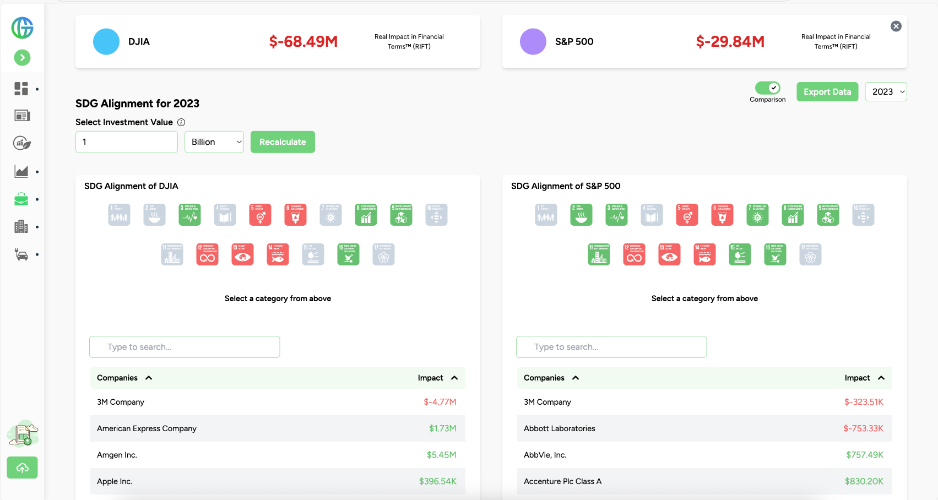
We measure companies’ Real Impact in Financial Terms (RIFT) across several ESG KPIs and impact pillars in alignment with impact accounting principles. Every RIFT Impact is then mapped to an SDG.
For instance, Scope 1, 2, and 3 emissions are captured within our GHG Emissions Impact pillar, which is mapped to SDG 13. This allows us to quantify companies' contributions to SDG 13 through their GHG emissions in dollar terms.
main use cases

Quantitative analysis

Equity research

ESG / Impact reporting

Benchmarking
360-degree
SDG assessment
SDG contribution via traditional ESG KPIs as well as companies’ products & services
10,000+
global public companies
UN SDGs Monetized Impact Data on public firms across all sectors
2015 - present
Historical data coverage with quarterly / monthly updates
Positive & negative contributions
WANT TO LEARN MORE?
Get early access to our latest features, industry insights, and updates.
Frequently Asked Questions
In this section, you will find answers to the most frequently asked questions related to this topic. The FAQ is designed to provide quick clarity on key concepts, features, and use cases, helping you better understand how our solutions work and how they can support your organization. We regularly update this section to reflect the most relevant questions and insights as our products and services evolve.
UN SDG Impact Alignment measures how a company's products, services, and operations contribute positively or negatively to the United Nations Sustainable Development Goals. It links corporate activities to specific SDGs using granular revenue and impact data.
Traditional SDG reporting often relies on qualitative disclosures or high-level indicators. UN SDG Impact Alignment uses quantitative, product-level data and monetized impact metrics to provide a more precise and comparable view of SDG contributions.
Company revenues are mapped to standardized products and services categories using the PSICS Revenue Datafeed. Each product group is then linked to relevant SDGs based on its measurable societal and environmental impact.
Monetized SDG impact expresses a company's positive and negative contributions to the SDGs in financial terms. This allows users to compare SDG performance across companies, sectors, and time using a consistent economic framework.
Yes, UN SDG Impact Alignment captures both positive and negative contributions. For example, emissions-related impacts are quantified and linked to SDG 13, enabling a balanced assessment of a company's overall SDG footprint.
UN SDG Impact Alignment data is used by investors, researchers, and sustainability teams to support ESG reporting, equity research, benchmarking, and impact-focused investment strategies.